


Umbra Penance

Custom software & SaaS · UK

Bespoke software for the processes off-the-shelf tools can't handle.

Client portals, internal tools, dashboards and SaaS platforms, designed around how your business works, with security designed in from the start. You own the code, the data and the infrastructure.

Describe what you need built
  • Free and no obligation
  • Pick a time straight after the form
  • You speak to one of the two founders
  • Shipped: Amadoo, a nursery-management SaaS
  • Security designed in from day one
  • You own the code
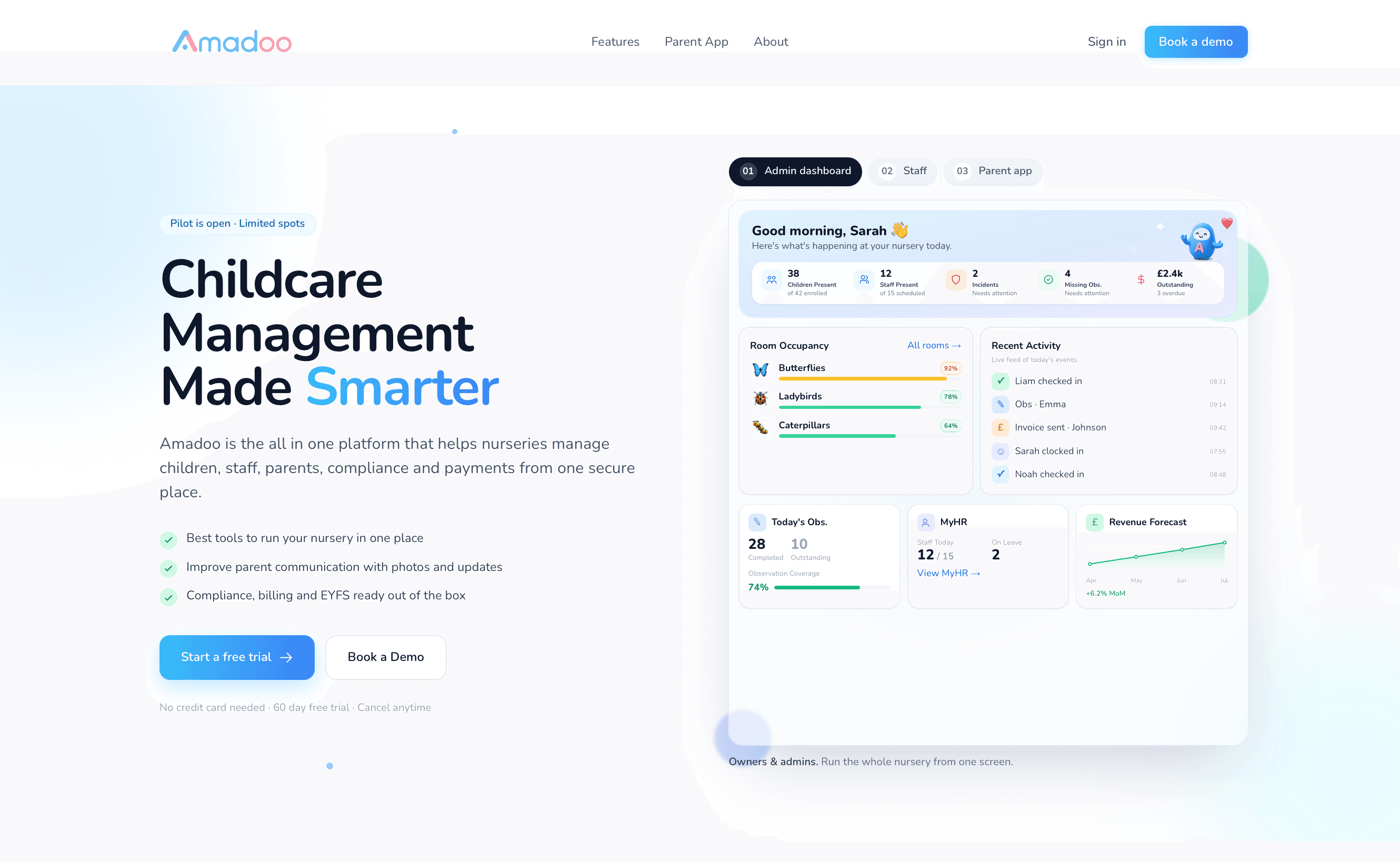
Amadoo nursery management platform home screen
Amadoo, a nursery-management platform we designed, built and security-tested end to end. Each nursery’s data is kept separate from every other’s.

You’ll speak with Adel or Mehdi, the founders who design, build and test every project. About us

Project

Already running in production.

Client: Amadoo, a nursery-management SaaS platform with a mobile app for parents and staff

Nursery SaaS · web + mobile app

A nursery-management SaaS, taken from concept to a working platform.

Problem
Amadoo needed one platform to run nurseries end to end, for four kinds of user, with payments, reporting and AI built in, without spending two years on the foundation.
What we built
The full product: multi-tenant web platform, role-based permissions, billing, messaging, attendance and curriculum, a React Native app for parents and staff, and Ami, an AI nursery assistant.
The hard part
Each nursery's data is locked to that nursery inside the database (20+ tables), with permissions for 12 staff roles.
Result
Amadoo went from concept to a working platform that runs nurseries in a single system, on a foundation built to scale.
Safeguards
Each nursery can only ever see its own data: the rule is enforced in the database itself, not only in the application. Role-based permissions for admins, managers, practitioners and parents, mapped to 12 distinct staff positions. Authentication and data access built on least-privilege principles, in place from the first version of the database.
“I would absolutely recommend Adel to any founder or business looking for a reliable technical partner.”

Ahmad Shawky, Founder, Amadoo
Read the full project

When it's time to stop forcing your process into generic SaaS

  • A spreadsheet has become the system the business depends on.
  • Clients chase updates by email because there's nowhere for them to look.
  • You pay for several tools and still stitch the picture together by hand.
  • The off-the-shelf product almost fits, and the workarounds now cost more than the licence.
  • You have a product idea that needs separate customer accounts, user roles and billing from launch.
Hand sketching an interface layout on paper

Design first

Architecture on paper before features in code.

Users, roles, data and security boundaries are agreed before anything is built. Changing a sketch costs minutes; changing a live system costs weeks.

What we build

  • Client portals

    Secure places for clients to see status, share documents, sign off and message, connected to your internal systems.

  • Internal business tools

    Admin panels, workflow apps and operational tools that replace the spreadsheet, with proper permissions and audit trails.

  • Dashboards & reporting

    Live numbers from your CRM, finance and operations systems in one view, without the monthly export.

  • SaaS platforms

    One platform serving many customers, with each customer's data kept apart, user roles, billing and an architecture ready to grow past the first customers.

  • Booking & scheduling tools

    Availability, payments and reminders shaped around how you actually sell.

  • APIs & integrations

    Backends and integration layers that let your systems, and your customers' systems, talk to each other reliably.

Security designed in from the start.

Adding security to a live product is slow and expensive. We design it in before the first feature.

  • Each customer's data is locked to them in the database itself, not just in the app.
  • Every type of user gets only the access their role needs.
  • Logins, sessions and stored keys reviewed before launch.

Engagements and pricing

Typical engagements

Fixed scope and price for each phase, agreed before work starts.

  • Scoping & prototype

    Workshops, architecture and a clickable or working prototype to validate the idea before full investment.

    Best for: New products and uncertain requirements.

  • Internal tool or portal

    A focused application replacing a spreadsheet or manual process, integrated with your existing systems.

    Best for: Operations teams and client-facing services.

  • SaaS platform build

    A product for many customers, with user roles, billing, integrations and a pre-launch security test, delivered in phases.

    Best for: Founders and businesses launching a product.

How pricing works: a free 20-minute call, then a written scope with a fixed price, then you decide. No day-rate surprises.

An example of a tool we build.

Example screens based on our builds: what the team sees. Names and figures are illustrative.

Sales performance

This month
Median first response11 min
Leads waiting > 24 h2
Calls this month115
Meetings booked41
SalespersonFirst responseLeads called within 1 hCalls
Emma R.4 min92%38
Liam K.9 min78%31
Priya S.17 min61%27
Owen T.42 min34%19
Example: an internal sales view built on call and CRM data captured automatically. Figures are illustrative.

Custom software is the right answer when…

The right call when

  • The process is core to how you make money or serve clients.
  • No product does it well enough, or the closest one forces painful workarounds.
  • You need control over data, security or integrations that SaaS won't give you.
  • Per-seat SaaS costs are growing faster than the value they deliver.

What we won’t recommend

  • A mature product already does it well. Buy it, and we'll integrate it.
  • The process isn't settled yet. Prove it with automation or a prototype first.
  • You can't commit to owning and maintaining the system. We'll tell you honestly.

How we work

How we take software from idea to production

  1. Discover

    Users, workflows, data and constraints. What must be true for this to be worth building.

  2. Architecture first

    How the data is organised, who can see what, and where the security boundaries sit, agreed with you before features are built.

  3. Build in increments

    Working software every cycle, on real data, so you can steer while it's cheap to change.

  4. Break it on purpose

    Before launch we try to break it: who can reach what, how features could be misused, and whether one customer can see another's data.

  5. Launch & hand over

    Deployed to infrastructure you own, documented, with optional ongoing support agreed in writing.

Technology

Modern, well-supported tools chosen so another team could maintain the system after us.

TypeScriptNext.jsReactReact NativeNode.jsPostgreSQLSupabaseREST & GraphQL APIsStripeVercel / cloud hosting

Questions we get asked

How much does custom software cost?
It depends on users, workflows, integrations and security requirements. A focused internal tool is a very different project from a multi-tenant SaaS platform. We scope in phases with a fixed price per phase, so you never commit to the whole build blind.
Do we own the code?
Yes. The code, data and infrastructure accounts are yours. We document the system so you can maintain it with us, in-house or with another team.
Can you work with our existing systems?
Yes. Most of what we build integrates with a CRM, accounting, identity provider or existing database. Integrations are scoped and tested as part of the build.
Do you build mobile apps?
Yes, with React Native, sharing the same backend as the web platform, so there's one system behind every screen. The parent and staff app we built for Amadoo, a nursery-management platform, works this way.
Should we build custom software or automate our existing tools?
Often automation first. If connecting the tools you have solves the problem, it's faster and cheaper. We recommend custom software when the process is core, unique, or has outgrown what no-code can do reliably.

Tell us what you're trying to build.

A 20-minute call with the engineer who would build it. We'll tell you whether custom software is the right answer and how we'd phase it.

Describe the project instead
  • Pick a time in the next step
  • Free, no obligation
  • 20 minutes on Google Meet